Monday, October 31, 2005
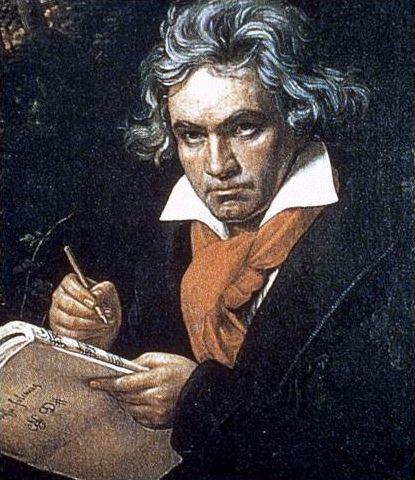
Have you ever wondered what Ludwig van Beethoven's last words were before his death? A somewhat macabre question, but totally appropriate on this Halloween evening. Here are some different composers' dying quotes:
- "Friends applaud, the comedy is over." - Ludwig van Beethoven, March 26th, 1827
- "The earth is suffocating... Swear to make them cut me open, so that I won't be buried alive." - Frederic Chopin, October 17th, 1849
- "Now I have finished with all earthly business, and high time too. Yes, yes, my dear child, now comes death." - Franz Lehar, October 24th, 1948
- "Ah, that tastes nice. Thank You." - Johannes Brahms, April 3rd, 1897
- "What's this?" - Leonard Bernstein, October 14th, 1990
- "I am a pianist." - John Field's response to the question "Are you a Papist or a Calvinist?", January 23rd, 1837
That's all I could find. Some people claim Beethoven's last words were "I shall hear in heaven," but that is more disputed than the above quote. If you have any more, write them in a comment. |
Subscribe:
+Yahoo
|
+Newsgator
|
+Bloglines
|
+Rojo
|
+Google
|
+Newsburst
|
+AOL
|
+MSN
|
+Blogroll
Translate: Español | Deutsche | Français | Italiano | Português
Well, here it is. The only playlist you need for Classical Halloween music. I'm spooked out already.
1. Toccata and Fugue in D minor, BWV 565 by Johann Sebastian Bach. Everyone's favorite.
Great, Free Download by Frederick Magle: http://www.magle.dk/music-forums/23-bach-toccata-fugue-d.html
2. Danse macabre, symphonic poem in G minor, Op. 40 by Camille Saint-Saens
3. Funeral March of a Marionette in D minor by Charles Gounod
4. Night on Bald Mountain by Modest Mussorgsky
5. Symphonie Fantastique: Dream of a Witches' Sabbath by Hector Berlioz
6. Peer Gynt Suite: In the Hall of the Mountain King by Edvard Grieg
7. The Sorcerer's Apprentice by Paul Dukas
8. Totentanz (I & II), for piano & orchestra, S. 126 (LW H8) Finale by Franz Liszt
9. The Planets: Uranus (The Magician) by Gustav Holst
10. The Firebird: Finale by Igor Stravinsky
I couldn't find too many free recordings, but I'm sure with some searching you will be able to find all that you need to spook out your trick-or-treaters tonight!
|
Subscribe:
+Yahoo
|
+Newsgator
|
+Bloglines
|
+Rojo
|
+Google
|
+Newsburst
|
+AOL
|
+MSN
|
+Blogroll
Translate: Español | Deutsche | Français | Italiano | Português
Sunday, October 30, 2005
Since I live in New Orleans, I would be remiss not to mention a way for Classical Music lovers to hear awesome musicians and help New Orleans get back on its feet at the same time. I came across this on Tanya Bannister's website. She is the winner of the 2005 New Orleans International Piano Competition.
Tanya, along with James Giles, Robert Henry and Petronel Malan, are touring the country with the Pianists for New Orleans tour. The series of concerts are supposed to raise $100,000 to benefit the Musical Arts Society of New Orleans. This is the organization that supports great Classical Music in New Orleans as well as the New Orleans International Piano Competition. So be sure to check the schedule for a concert near you and help New Orleans!
Also check out the Audio section on Tanya's website for some great performances including a full performace of Rachmaninoff's Rhapsody on a Theme of Paganini. While you're listening be sure to read my previous post on Rachmaninoff's Works for Piano and Orchestra
|
Subscribe:
+Yahoo
|
+Newsgator
|
+Bloglines
|
+Rojo
|
+Google
|
+Newsburst
|
+AOL
|
+MSN
|
+Blogroll
Translate: Español | Deutsche | Français | Italiano | Português
So, I've been so busy with trying to promote the blog that I've been lacking on my content. To all the devoted readers out there, I'm so sorry. But I think you all will appreciate some of the changes. Let me tell you what I have done so far. For those of you who have a blog or website, get your pencils ready:
1. I have added a FeedBurner Feed. I got rid of that old-fashioned atom.xml feed that Blogger provides. Now you can add my feed to whatever newsreader or aggregator you use. Just use the simple buttons on the sidebar to add my feed.
2. I now have Chitika eMiniMalls. This is the ad you see at the top of the page here. It will display relevant products to the context of my site, although I can't set it to contextual mode because it would conflict with the Google AdSense's terms of service. It is still really cool because it displays a product, description, best deals, and a search box. Also if you have a website or blog of your own, you can click this link to apply to put Chitika on your site. I highly recommend it.
3. I now have MyBlogLog. It is an excellent tracking feature that tells webmasters where their traffic is coming from and where it is going. It is a free service, but one can also pay a small fee to get much more detailed and powerful statistics. To sign up, click this link.
Well, those are the major updates I have made to the site in the last few days, and you can see why I haven't updated the content. However, that will all change because I intend to update much, much more frequently starting today. Don't forget to subscribe to the feed. Thanks. |
Subscribe:
+Yahoo
|
+Newsgator
|
+Bloglines
|
+Rojo
|
+Google
|
+Newsburst
|
+AOL
|
+MSN
|
+Blogroll
Translate: Español | Deutsche | Français | Italiano | Português
Thursday, October 27, 2005
| The idea would seem absurd to most Classical Music afficionados that I know. I have to admit that I find it a little bit odd, too. That idea is a series of concerts in Japan where sleeping is not frowned upon, but rather, it is encouraged! These concerts are taking place at Hakuju Hall in Tokyo, a venue designed specifically for relaxation and to harness the healing power of music. The hall even features reclining seats, but only in the back to keep the noise from snorers down! 10 concerts are held per year as part of the Reclining Concert Series. The full article can be found here. |
Subscribe:
+Yahoo
|
+Newsgator
|
+Bloglines
|
+Rojo
|
+Google
|
+Newsburst
|
+AOL
|
+MSN
|
+Blogroll
Translate: Español | Deutsche | Français | Italiano | Português
Wednesday, October 26, 2005

The final version of Liszt's Piano Concerto No. 1 in E flat major, S. 124 dates 1856, however, the beginning of the composition dates to 1830 when Liszt sketched the main theme in a notebook. Liszt commenced serious work on the composition in the 1840s. It could be said that Liszt spent so long on the composition because he was fairly new at this point to the realm of orchestration. Up to this point, almost everything he wrote was for the keyboard. He even enlisted the help of his pupil Joachim Raff with the task of orchestration. The concerto was completed in 1849, but Liszt revised it several times until he arrived at the form we know and love today. There are at least six complete drafts of the concerto. Many bear the title Concerto symphonique showing Liszt's intention to have the orchestra play just as vital a role as the soloist. Liszt was influenced by Henry Litolff, to whom the work is dedicated, in this idea of equal parts for orchestra and soloist.
The concerto consists of three main sections: Allegro maestoso, Quasi adagio-Allegretto vivace-Allegro animato, and Allegro marziale animato. These three sections form one large-scale seamless whole with no pauses in between. The first movement begins with a very powerful and recognizable motif of which Liszt allegedly wrote, "'Das versteht Ihr alle nicht' ('This none of you understands'). Liszt employs blistering octave passages for the piano as he so frequently does. The main theme then reappears in a more tranquil form. The piano introduces the second subject after which the piano is joined by the clarinet in a serene duet. This charming passage is soon overtaken by the main theme again, but this time in an overpowering and almost furious tone.
Muted strings introduce the second section with a cantabile melody. The piano soon takes up the theme. As the mood grows more reflective, dramatic bursts from the orchestra ensue with improvisatory passages for the piano interspersed. The tempo quickens with flute, and then oboe and clarinet taking up the theme. A more lighthearted mood follows being introduced by the sounding of a triangle. It is with the use of the triangle that Liszt incurred much unnecessary criticism. Present day listeners may think nothing of the use of the triangle, but at the time of the concerto's premiere it was nothing short of revolutionary. A particulary sneering critic, Eduard Hanslick described the work as Liszt's "Triangle Concerto."
The piano soon introduces a cheerful theme in its upper register with other instruments gradually joining in, and all the while, the notorious triangle adds to the effect. The mood soon turns darker with the reappearance of the main theme. The piano introduces the final section with a quicker guise of the cantabile theme. Various themes make reappearances in some form or another until the concerto comes near an end with thunderous phrases and virtuosic octave passages for the piano. The concerto closes in the bravura style which Liszt has become known for.
For more on Liszt, see my Dante Symphony posting.Labels: Liszt |
Subscribe:
+Yahoo
|
+Newsgator
|
+Bloglines
|
+Rojo
|
+Google
|
+Newsburst
|
+AOL
|
+MSN
|
+Blogroll
Translate: Español | Deutsche | Français | Italiano | Português
Friday, October 21, 2005
So, I recently heard Richard Addinsell's Warsaw Concerto on my local Classical Music radio station and I was pretty impressed by it. It is not a typical concerto in that it only has one movement. Also, it is extremely brief, with an average duration of just under 10 minutes. However, it has become pretty famous nonetheless.
The "concerto" was featured in the 1941 British film Dangerous Moonlight, later known as Suicide Squadron. Originally, the filmmakers wanted to use Rachmaninoff's Piano Concerto No. 2. Instead, they decided to commision a similar work from Addinsell along with orchestrator Roy Douglas.
The film revolves around the main character who is a Polish piano virtuoso who also happens to be a combat pilot who finds himself in England during the Battle of Britain taking refuge from the German occupation of Poland. In the movie, he is the composer of this work, which repeatedly reappears as incidental music and also in a concert which is worked into the story of the film.
The work contains almost every bit of passion and nostalgia as that of Rachmaninoff's. Audiences of the movie loved the concerto, which quickly found its way onto recordings and various sheet music adaptations. Just like Rachmaninoff's concertos, the theme of the Warsaw Concerto was even used for popular songs, in this case the song "The World Outside."
The opening of the concerto is quite dramatic in the style of Grieg's Piano Concerto in A minor with a thundering piano entrance supported by timpani. In the second theme, Addinsell borrows from Rachmaninoff quite heavily with an extremely lyrical passage. However, one should not think less of the composition for its borrowing, because it is a very skillful work indeed. Much music of this nature has appeared in films, but Addinsell's concerto struck a chord with listeners who were at such a dark point in history in 1941.
For more on Rachmaninoff's concertos, see my previous posting.
No Need to Click Here - I'm just claiming my feed at Feedster |
Subscribe:
+Yahoo
|
+Newsgator
|
+Bloglines
|
+Rojo
|
+Google
|
+Newsburst
|
+AOL
|
+MSN
|
+Blogroll
Translate: Español | Deutsche | Français | Italiano | Português
Tuesday, October 18, 2005
(Note: While you are reading this, be sure to download the many different versions of this work with eMusic's free trial. You get 50 mp3s for free no matter what with no obligations.)
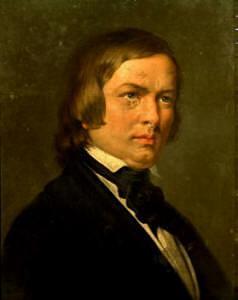
A favorite choice for concert pianists' recitals seems to be Robert Schumann's Symphonic Etudes, Op. 13. It is well-suited for the concert hall containing virtuosic passages, expressive movements and a thrilling conclusion.
Schumann's contributions to the Etude genre follow closely in the footsteps of Frederic Chopin and Franz Liszt. However, the etudes are based on a single theme. Schumann also called the work "Etudes in the form of variations." This contributes to the overall seamlessness of the etudes and helped to establish its presence in the concert halls.
Schumann composed the Symphonic Etudes in 1834, but later revised the work in 1852. There were originally eighteen etudes in the set. Schumann felt that at this length and difficulty it would be too draining and demanding of the pianist and later cut the number down to twelve etudes. This made the work a little bit more agreeable to the pianist as well as the listener. When Johannes Brahms republished the etudes in the 1890s, he selected five additional etudes to add to the set. These are now frequently included in performances and recordings.
The theme that the etudes are based on was composed by Baron von Fricken, the amateur musician father of Schumann's short-term fiancee Ernestine von Fricken. It is in the key of C Sharp Minor and is quite tragic in character. This moves into a dirgelike march for the first etude. The next etude is Andante and is in the style of a rolling nocturne. The next etude is an energectic Vivace composed of a staccato like texture. The fourth etude is Allegro Marcato and uses a canon form in octaves that starts out with the theme but digresses quickly.
In the fifth, Scherzando etude, a key change is made to the key of E major. Following the fifth etude, the sixth etude is a study in syncopation. Like the fifth etude, the seventh etude shifts into E major with a crescendo and dazzling display of virtuosic writing. Next comes an intricately ornamented eighth etude.
The ninth etude is marked Presto Possibile, which means as fast as possible, a daunting tempo for any budding pianist! It is scherzo-like and one of the most challenging of the set. The theme is barely present in this etude. The tenth etude has a light and airy demeanor. However, the eleventh etude, cast in G sharp minor, is very somber and brings the listener into the darkest depths.
The listener is brought out of this dreariness by the 12th and final etude. This etude is in the key of D flat major. It strays from the main theme altogether. Instead, Schumann uses a theme from an opera by Heinrich Marschner. This Allegro Brillante etude brings the work to a thrilling conclusion with its dotted rhythms and optimistic jubilism.
I highly recommend the recording by Vladimir Ashkenazy from the 7 CD set of Schumann's Works for Solo Piano on the Decca label. He includes the extra etudes that I had previously mentioned.Labels: Schumann |
Subscribe:
+Yahoo
|
+Newsgator
|
+Bloglines
|
+Rojo
|
+Google
|
+Newsburst
|
+AOL
|
+MSN
|
+Blogroll
Translate: Español | Deutsche | Français | Italiano | Português
Monday, October 17, 2005

(Note: While you are reading this, be sure to download the many different versions of this work with eMusic's free trial. You get 50 mp3s for free no matter what with no obligations.)
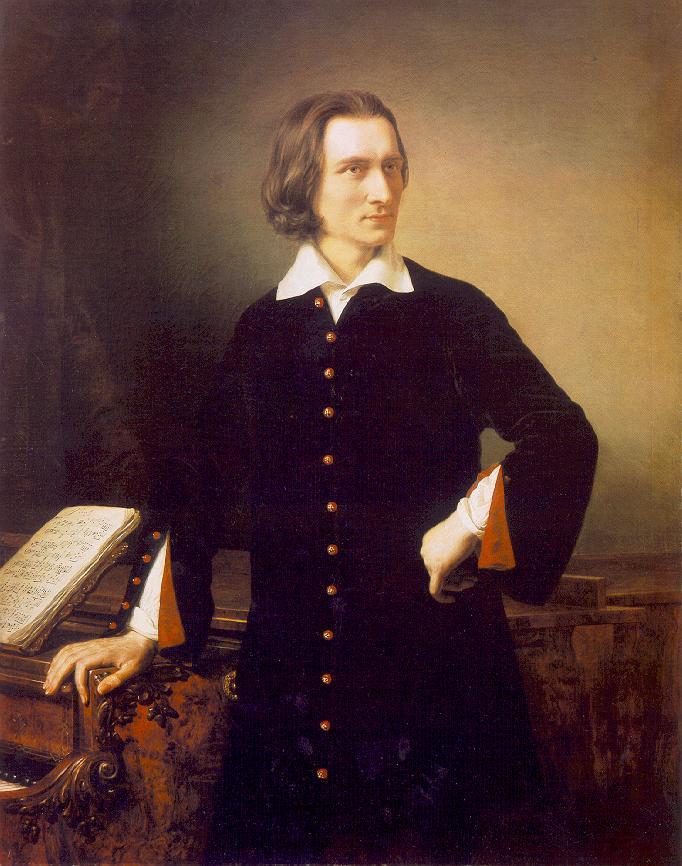
Almost every composer has been inspired to write at least one piece of music based on a work of literature. Dante Alighieri's Divine Comedy has indeed inspired a great number of composers. One of these was Franz Liszt. He first became interested in the work in the early 1830's upon being introduced to it by his mistress of the time, Marie D'Agoult.
First Liszt composed his Après une lecture du Dante, fantasia quasi sonata also knows as the "Dante" Sonata for solo piano. However, he always intended to write a large scale orchestral work based on the poetry. He didn't do this until his most productive years during his conducting post in Weimar.
The "Dante" Symphony (Eine Symphonie zu Dantes Divina Commedia) was composed during the same period in which Liszt composed his "Faust" Symphony. Liszt intended to write a seperate movement for each section of the Divine Comedy: "Inferno", "Purgatorio" and "Paradiso." However, Liszt's friend and soon to become son-in-law, Richard Wagner convinced Liszt that it wasn't possible for a mere mortal to portray Paradise in music. Thus, much to the detriment of the work, Liszt reconsidered the work and instead inserted a choral version of the Magnificat. It does not fit into the structure and texture of the symphony and many feel this explains its absence from the general symphonic repertory.
The first movement is in ternary form and seeks to portray the characters that Dante describes in his version of hell. Liszt illustrates his intent for the poetry and music to become one by frequently including verses from the poem underneath the score of the work almost as if it is set to be sung. Liszt's orchestration paints a vivid picture with the use of low brasses and double basses followed by the high brasses as if echoing the inscription above the gates of hell: "Abandon all hope, ye who enter." The first section of the movement reaches a thundering climax representing the emotional state of Dante as he begins his journey through hell.
The middle section of the movement focuses on the tragic tale of the lovers Francesca and Paola, a subject that would later be the inspiration for Tchaikovsky's Francesca da Rimini. Liszt now uses the full sentimental power of the strings, flutes and harp as opposed to his crashing brass as in the first section. Following a cadenza for the harp, the finale proceeds with a crash once again. Here Liszt marks the movement as "blasphemous and sardonic." The first movement finishes with an intense, blaring conclusion.
The second movement, Purgatorio, is far more quiet and reflective as Dante passes from the terrifying Inferno into the relatively blissful by comparison Purgatory. Liszt employs a reverent fugue based much on the descending melodic motif used in the first movement. After the women's voices issue the final Magnificat, the movement ends in a state of tranquility. Liszt eventually composed a version that ends with a fortissimo passage, however, it is considered a radical alternative to the first version.
Liszt wrote a tremendous amount of programattic music, that is music that is intended to tell a story. In fact, he probably wrote more of this type of music than any other composer. He is considered the father of the now popular form of the Symphonic Poem. Indeed he was a true master at using his music to portray different stories or images.
An excellent recording of the Dante Symphony that also features the Dante Sonata is that of Daniel Barenboim with the Berlin Philharmonic.Labels: Liszt |
Subscribe:
+Yahoo
|
+Newsgator
|
+Bloglines
|
+Rojo
|
+Google
|
+Newsburst
|
+AOL
|
+MSN
|
+Blogroll
Translate: Español | Deutsche | Français | Italiano | Português
Saturday, October 15, 2005
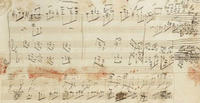
From wikipedia:
"On October 13, 2005 it was reported that an authentic 179 year-old Beethoven
manuscript titled "Grosse Fuge" (a piano four-hands version of the Op. 133
string quartet finale) was found by a Pennsylvania librarian at the Palmer
Theological Seminary in Wynnewood, Pennsylvania in July 2005. It had been
missing for 115 years. The manuscript is to be auctioned by Sotheby's Auction
House on December 1, 2005: estimated value is one and one half to two million
dollars. The manuscript was listed in an 1890 catalogue and sold at an auction
in Berlin to a Cincinnati, Ohio industrialist. His daughter gave it and other
manuscripts including Mozart's Fantasia to a church in Philadelphia,
Pennsylvania in 1952. It is not known how the Beethoven manuscript came to be in
the possession of the library."
I think that is pretty exciting!!!Labels: Beethoven |
Subscribe:
+Yahoo
|
+Newsgator
|
+Bloglines
|
+Rojo
|
+Google
|
+Newsburst
|
+AOL
|
+MSN
|
+Blogroll
Translate: Español | Deutsche | Français | Italiano | Português
Thursday, October 13, 2005
Has anyone ever wondered why a CD holds 74 minutes of music? Why not 60 or 64? Well, I came across an interesting urban legend today that may just be the answer. It may not be a coincidence that the size of a CD is just big enough to hold a complete recording of Ludwig van Beethoven's Ninth Symphony.
Philips and Sony collaborated to produce the Compact Disc. The orginal prototype was an 11.5 cm, 14-bit disc that held 60 minutes of music. However, Sony president Norio Ohga insisted that the format was too small. He proposed a 12 cm, 16-bit disc that held 74 minutes of music. Coincidentally, Beethoven's Ninth Symphony just happened to be Ohga's favorite classical work. It also happened to be Sony chairman Akio Morita's wife's favorite as well.
Another explanation is that the legendary conductor Herbert von Karajan demanded that a disc be able to hold a recording of the symphony. Karajan was a big proponent of the Compact Disc's development and many claim that his recording of the Ninth Symphony was indeed the reference for how long the disc should be.
I'd love to hear what everyone thinks on this. Legend or reality? Leave a comment.Labels: Beethoven |
Subscribe:
+Yahoo
|
+Newsgator
|
+Bloglines
|
+Rojo
|
+Google
|
+Newsburst
|
+AOL
|
+MSN
|
+Blogroll
Translate: Español | Deutsche | Français | Italiano | Português

One of my favorite piano concertos besides those of Rachmaninoff, of course, would have to be Beethoven's Fifth and final piano concerto. Aptly titled the "Emperor" concerto, the work, almost 40 minutes long, is grand and almost symphonic in scale. As is the case with the "Moonlight Sonata" for piano and the "Spring Sonata" for violin and piano, the nickname is not that of Beethoven, but it still seems to fit quite well for the piece.
The composition dates mainly from early 1809. It came right on the heels of another large-scale work that Beethoven composed for piano and orchestra, the Choral Fantasy. The concerto is in the key of E flat, a key that Beethoven returned to over and over again. One of Beethoven's most important works, the "Eroica" Symphony is also in this key. Indeed, the concerto is not unlike the "Eroica" in its use of broad phrases to sustain large amounts of material and key shifts.
In the Fourth Piano Concerto, Beethoven dispensed with tradition and gave the opening of the concerto to the soloist. In the Fifth Piano Concerto, however, both soloist and orchestra are present at the beginning of the movement. Beethoven begins the first movement with a series of cadential passages for the piano. Before each piano cadenza, the orchestra states a chord in the progression of I-IV-V7-I, and the piano elaborately expands on these chords with a flourish. Of course, what is strange about this, is that traditionally, the cadenza would be found near the end of the first movement of the concerto. Beethoven breaks from the mold even further by not having a cadenza for the soloist at the end of the movement, but rather has a brief flourish written out for the soloist before concluding the movement. The effect of the movement is extremely powerful and heroic, just as is the "Eroica". The first movement is expansive being 20 minutes long.
The concerto shifts moods in the second movement - Adagio un poco moto. It is one of Beethoven's most beautiful movements, conjuring up sounds like that of Chopin to come. It is not a virtuosic movement, but rather a movement of simplicity and lyrical delight. The piano is underscored by sparse wind and string accompaniement. The effect is incredibly soothing and tender. The movement is in the tonic key of B major, a shift of a major third from the first movement. Beethoven employs the same major third shift in his Third Piano Concerto from C minor to E major. This shift contributes greatly to the offsetting effect of the movement.
There is no break between the second and final movements of the concerto. Rather, Beethoven employs a semitone drop from B major to B flat at the end of the second movement followed by the tentative introduction of the Rondo theme by the piano. In contrast to the stately magnificence of the opening Allegro, the Rondo takes on an exuberant form that is quite cheerful. Once again, there is no improvisatory cadenza to be found, however, Beethoven employs much cadenza-like writing for the piano. Near the end of the movement, a point of considerable calm is reached where the piano and timpani join in a sustained duet before the full orchestra returns in a quick and vigorous conclusion to the concerto.
Whereas Beethoven's first four concertos were written for his own use on the stage, Beethoven never performed this work. His withdrawal from writing concertos is undoubtedly linked to his increasing deafness and declining career as a pianist that resulted from it. The first public performance of the work is most likely that of Friedrich Schneider on 28 November 1811 at a concert in Leipzig. Carl Czerny, Beethoven's celebrated pupil, also performed the work in that year. It was published in London in 1810 and in Leipzig early in 1811. Of course, Beethoven would not have liked the moniker of "Emperor" that the concerto received with its Bonapartean connotation, but that is the name that has been passed on and that the world has come to love it as.
Download "The Emperor" with eMusic's free trial:
 Labels: Beethoven |
Subscribe:
+Yahoo
|
+Newsgator
|
+Bloglines
|
+Rojo
|
+Google
|
+Newsburst
|
+AOL
|
+MSN
|
+Blogroll
Translate: Español | Deutsche | Français | Italiano | Português
Wednesday, October 12, 2005
Well, my previous post on Salieri has seemed to stir up a decent amount of interest, so I figured I would write some more on the actual music of Salieri. More and more recordings of Salieri's music are finding there way onto the market. Of course, Salieri's main output was opera, but he did venture into other venues as well.
One of my favorite recordings is that of the Philharmonia Orchestra under the baton of Pietro Spada on the ASV Digital label. The recording features Salieri's Two Piano Concertos as well as his Variazioni Sulla "Follia di Spagna" or Variation on the Leaves of Spain. Also included on the recording are the world premieres of his Les Horaces and Semiramide Overtures.
Spada edited many of the works and the cadenza for the Piano Concerto in C is his own. I must say that I find the Piano Concertos to be very well written. They are written in a nostalgic style but at the same time are forward-looking pointing to the supreme piano concertos by Mozart.
However, the Variazioni Sulla "Follia di Spagna" is where Salieri really shines. Written in 1815, near the onset of Salieri's senility, it was the composer's last work. The theme is one of the most popular in all of Classical Music. It has been used by D'Anglebert, Corelli, Daquin, Liszt, and Rachmaninov. Salieri shows that he is indeed no dolt and, rather, a master of orchestration. The variations run the gamut from quiet and simplistic to complex and powerful. The overtures are also a real delight. I highly recommend checking out this recording.
While only a few of Salieri's many operas have been recorded so far, I feel this will soon change. The talented mezzo-soprano, Cecilia Bartoli, released a fabulous album in 2003 entitled The Salieri Album. She believes the tribute will help to "accord him the status he deserves." The arias on the album range from comical to highly dramatic. It shows that Salieri was comfortable with writing both as is Bartoli singing both styles. Adam Fischer conducts the Orchestra of the Age of the Enlightenment on the album. It truly is a gem to not be missed.Labels: Salieri |
Subscribe:
+Yahoo
|
+Newsgator
|
+Bloglines
|
+Rojo
|
+Google
|
+Newsburst
|
+AOL
|
+MSN
|
+Blogroll
Translate: Español | Deutsche | Français | Italiano | Português
Monday, October 10, 2005
(Note: While you are reading this, be sure to download the many different versions of this work with eMusic's free trial. You get 25 mp3s for free no matter what with no obligations.)
If you have ever been to a wedding with a really first-rate organist at the keyboard, then you have probably heard Charles-Marie Widor's Toccata. I first heard of this piece when I attended a Pipe Organ Encounter sponsored by the American Guild of Organists. All of the others attending couldn't stop talking about this piece and once I heard it, I understood why. It is a pyrotechnical masterpiece showcasing all of the power and fury that a grand pipe organ is capable of.
Widor is best remembered today for the Toccata, but he was a brilliant composer, organist and teacher. His students included Darius Milhaud, Marcel Dupre and Louis Vierne. He was the organist at the Church of Saint Sulpice in Paris, a position he held for 67 years.
Widor wrote a total of ten symphonies for the organ. They were daunting compositions in scale, transferring all of the power and complexity of an orchestra to the organ. The Toccata is the showstopping finale of Widor's Organ Symphony No. 5 written in 1887. The toccata is a form that can be traced back to the baroque period and indeed Widor's Toccata could be compared to a composition of J.S. Bach, with its complex weaving and improvisitory use of a single motif. Interestingly, Widor's education on the organ can be traced in an unbroken line back to Bach himself.
With the Toccata being used increasingly often as a recessional piece for weddings, the music of Widor is being rediscovered. He wrote for more than just organ and many of his works have yet to be explored.
 Labels: Widor |
Subscribe:
+Yahoo
|
+Newsgator
|
+Bloglines
|
+Rojo
|
+Google
|
+Newsburst
|
+AOL
|
+MSN
|
+Blogroll
Translate: Español | Deutsche | Français | Italiano | Português
(Note: While you are reading this, be sure to download the many different versions of this work with eMusic's free trial. You get 25 mp3s for free no matter what with no obligations.)
A piece that I have recently come to love is Maurice Ravel's La Valse. My first exposure to the piece was at the 2004 New Orleans International Piano Competition. While the piece was originally written for orchestra, it was also arranged for solo piano by Ravel. Alexander Moutouzkine, the Gold Medalist, performed a brilliant rendition of the piece that garnered an immediate standing ovation from the audience. I think that the piece truly captivated the audience as I too was captivated.
Ravel composed the piece during 1919-1920. He had intended to compose the piece many years prior to this date, but what he ended up writing was his Valses nobles et sentimentales. Ravel wanted to write the piece as a tribute to Johann Strauss Jr. He described the idea for the work as "a kind of apotheosis of the Viennese waltz, mingled in my mind with the idea of destiny's fantastic whirl."
However, Ravel's intentions were skewed by the onslaught of the First World War. He no longer had such a kind view of Vienna. In 1919, Serge Diaghilev requested from Ravel a new work for his Paris based Ballets Russes. Ravel returned to his concept of a Viennese waltz, however, this time he called it La Valse, a piece that now took on a more sinister and grotesque form than the whimsical idea he once had for it.
Ravel's program notation in the original score gives an insight into the piece:
"Through rifts in swirling clouds, couples are glimpsed waltzing. As the clouds disperse little by little, one sees an immense hall peopled with a whirling crowd. The scene becomes progressively brighter. The light from chandeliers bursts forth at fortissimo (letter B in the score). An Imperial Court, around 1855."
Amazingly, anyone with an imagination can vividly picture exactly what Ravel described when listening to the work. Ravel once again proved his mastery of orchestration, scoring the piece for a large orchestra including triple winds, two harps, five drums and various metal percussion.
Shortly after the composition of La Valse, Diaghilev requested a four-hand reduction of the piece for piano. Ravel played his reduction with Marcelle Meyer at the second piano for Diaghilev and many other guests including Stravinsky and Poulenc. Poulenc was very impressed with the piece, but later recalled that Stravinsky didn't seem to be very enthused. "Stravinsky said not a word! I was 22, and, you can imagine, absolutely flabbergasted. Ravel proceeded to give me a lesson in modesty that has lasted all my life: he picked up his music quietly and, without worrying what we all thought of it, calmly left the room," recalled Poulenc.
The piece did not catch on very well as the "Choreographic Poem" which Ravel entitled it to be. However, it has enjoyed immense success as a concert piece in many different forms including arrangements for orchestra, piano duet and piano solo. It is particularly striking in its piano duet form. Some may be familiar with Martha Argerich's recordings of the work with Nelson Friere. Watching a live performance of the piece on video had me on the edge of my seat the entire time as the suspense heightened to frenetic levels until the string-popping climax.Labels: Ravel |
Subscribe:
+Yahoo
|
+Newsgator
|
+Bloglines
|
+Rojo
|
+Google
|
+Newsburst
|
+AOL
|
+MSN
|
+Blogroll
Translate: Español | Deutsche | Français | Italiano | Português







Comments on "The Last Words of the Great Composers"
post a comment