Tuesday, December 06, 2005

It took one of the most powerful X-Rays in the world, but scientists were able to prove conclusively at last that Ludwig van Beethoven died from lead poisoning. They focused the beam on six pieces of his hair and small fragments of his recently discovered skull.
The study took place at the Energy Department's Argonne National Laboratory outside of Chicago. It had long been speculated that lead poisoning could have been the cause of Beethoven's death. What is uncertain is how Beethoven came to be exposed to such great amounts of lead. It is possible that the source was his lead drinking cups which he frequently drank wine from. Another possibility is that the lead came from medical treatments which he received. Treatments from the 19th century frequently contained traces of heavy metals such as lead. Also, the actual containers for the medicines back then were frequently leaded glass bottles.
Another important finding was that there was no mercury present. This further discredits the theory that Beethoven had syphilis which was treated with mercury in those times.
Beethoven's hair samples contained 60 parts per million of lead. This is 100 times higher than the normal amount found in most humans.
As early as his twenties, Beethoven started to have medical symptoms that indicated he may have lead poisoning such as severe stomach problems. By his late twenties Beethoven was deaf. However, it is not believed that the lead poisoning brought about the deafness.
And so, at last, the long speculated cause of death has been answered for this great composer. Now, if only we could figure out the cause of Mozart's death!
[From The Washington Post]
 Labels: Beethoven |
Subscribe:
+Yahoo
|
+Newsgator
|
+Bloglines
|
+Rojo
|
+Google
|
+Newsburst
|
+AOL
|
+MSN
|
+Blogroll
Translate: Español | Deutsche | Français | Italiano | Português
Thursday, December 01, 2005
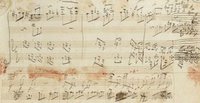
The recently discovered Beethoven score that I posted on in Ludwig van Beethoven's Lost Manuscript has been sold at auction for an astonishing 1.9 million dollars.
An anonymous buyer bought the score that was expected to go for up to 2.6 million dollars.
The "Grosse Fuge" was written by Beethoven in 1826, a year before his death. The manuscript contains numerous corrections and deletions by the composer providing an insight into the manner in which he composed.
The last time the manuscript was seen in public before its July discovery at the Palmer Theological Seminary was at an 1890 Berlin auction.
This falls far short of the record price paid for a Beethoven score. In 2003, a working manuscript for Beethoven Ninth Symphony was purchased for about 3.6 million dollars. A small price to pay for such a monumental work.
[From BBC News]
 Labels: Beethoven |
Subscribe:
+Yahoo
|
+Newsgator
|
+Bloglines
|
+Rojo
|
+Google
|
+Newsburst
|
+AOL
|
+MSN
|
+Blogroll
Translate: Español | Deutsche | Français | Italiano | Português
Saturday, October 15, 2005
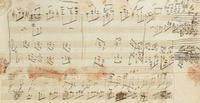
From wikipedia:
"On October 13, 2005 it was reported that an authentic 179 year-old Beethoven
manuscript titled "Grosse Fuge" (a piano four-hands version of the Op. 133
string quartet finale) was found by a Pennsylvania librarian at the Palmer
Theological Seminary in Wynnewood, Pennsylvania in July 2005. It had been
missing for 115 years. The manuscript is to be auctioned by Sotheby's Auction
House on December 1, 2005: estimated value is one and one half to two million
dollars. The manuscript was listed in an 1890 catalogue and sold at an auction
in Berlin to a Cincinnati, Ohio industrialist. His daughter gave it and other
manuscripts including Mozart's Fantasia to a church in Philadelphia,
Pennsylvania in 1952. It is not known how the Beethoven manuscript came to be in
the possession of the library."
I think that is pretty exciting!!!Labels: Beethoven |
Subscribe:
+Yahoo
|
+Newsgator
|
+Bloglines
|
+Rojo
|
+Google
|
+Newsburst
|
+AOL
|
+MSN
|
+Blogroll
Translate: Español | Deutsche | Français | Italiano | Português
Thursday, October 13, 2005
Has anyone ever wondered why a CD holds 74 minutes of music? Why not 60 or 64? Well, I came across an interesting urban legend today that may just be the answer. It may not be a coincidence that the size of a CD is just big enough to hold a complete recording of Ludwig van Beethoven's Ninth Symphony.
Philips and Sony collaborated to produce the Compact Disc. The orginal prototype was an 11.5 cm, 14-bit disc that held 60 minutes of music. However, Sony president Norio Ohga insisted that the format was too small. He proposed a 12 cm, 16-bit disc that held 74 minutes of music. Coincidentally, Beethoven's Ninth Symphony just happened to be Ohga's favorite classical work. It also happened to be Sony chairman Akio Morita's wife's favorite as well.
Another explanation is that the legendary conductor Herbert von Karajan demanded that a disc be able to hold a recording of the symphony. Karajan was a big proponent of the Compact Disc's development and many claim that his recording of the Ninth Symphony was indeed the reference for how long the disc should be.
I'd love to hear what everyone thinks on this. Legend or reality? Leave a comment.Labels: Beethoven |
Subscribe:
+Yahoo
|
+Newsgator
|
+Bloglines
|
+Rojo
|
+Google
|
+Newsburst
|
+AOL
|
+MSN
|
+Blogroll
Translate: Español | Deutsche | Français | Italiano | Português

One of my favorite piano concertos besides those of Rachmaninoff, of course, would have to be Beethoven's Fifth and final piano concerto. Aptly titled the "Emperor" concerto, the work, almost 40 minutes long, is grand and almost symphonic in scale. As is the case with the "Moonlight Sonata" for piano and the "Spring Sonata" for violin and piano, the nickname is not that of Beethoven, but it still seems to fit quite well for the piece.
The composition dates mainly from early 1809. It came right on the heels of another large-scale work that Beethoven composed for piano and orchestra, the Choral Fantasy. The concerto is in the key of E flat, a key that Beethoven returned to over and over again. One of Beethoven's most important works, the "Eroica" Symphony is also in this key. Indeed, the concerto is not unlike the "Eroica" in its use of broad phrases to sustain large amounts of material and key shifts.
In the Fourth Piano Concerto, Beethoven dispensed with tradition and gave the opening of the concerto to the soloist. In the Fifth Piano Concerto, however, both soloist and orchestra are present at the beginning of the movement. Beethoven begins the first movement with a series of cadential passages for the piano. Before each piano cadenza, the orchestra states a chord in the progression of I-IV-V7-I, and the piano elaborately expands on these chords with a flourish. Of course, what is strange about this, is that traditionally, the cadenza would be found near the end of the first movement of the concerto. Beethoven breaks from the mold even further by not having a cadenza for the soloist at the end of the movement, but rather has a brief flourish written out for the soloist before concluding the movement. The effect of the movement is extremely powerful and heroic, just as is the "Eroica". The first movement is expansive being 20 minutes long.
The concerto shifts moods in the second movement - Adagio un poco moto. It is one of Beethoven's most beautiful movements, conjuring up sounds like that of Chopin to come. It is not a virtuosic movement, but rather a movement of simplicity and lyrical delight. The piano is underscored by sparse wind and string accompaniement. The effect is incredibly soothing and tender. The movement is in the tonic key of B major, a shift of a major third from the first movement. Beethoven employs the same major third shift in his Third Piano Concerto from C minor to E major. This shift contributes greatly to the offsetting effect of the movement.
There is no break between the second and final movements of the concerto. Rather, Beethoven employs a semitone drop from B major to B flat at the end of the second movement followed by the tentative introduction of the Rondo theme by the piano. In contrast to the stately magnificence of the opening Allegro, the Rondo takes on an exuberant form that is quite cheerful. Once again, there is no improvisatory cadenza to be found, however, Beethoven employs much cadenza-like writing for the piano. Near the end of the movement, a point of considerable calm is reached where the piano and timpani join in a sustained duet before the full orchestra returns in a quick and vigorous conclusion to the concerto.
Whereas Beethoven's first four concertos were written for his own use on the stage, Beethoven never performed this work. His withdrawal from writing concertos is undoubtedly linked to his increasing deafness and declining career as a pianist that resulted from it. The first public performance of the work is most likely that of Friedrich Schneider on 28 November 1811 at a concert in Leipzig. Carl Czerny, Beethoven's celebrated pupil, also performed the work in that year. It was published in London in 1810 and in Leipzig early in 1811. Of course, Beethoven would not have liked the moniker of "Emperor" that the concerto received with its Bonapartean connotation, but that is the name that has been passed on and that the world has come to love it as.
Download "The Emperor" with eMusic's free trial:
 Labels: Beethoven |
Subscribe:
+Yahoo
|
+Newsgator
|
+Bloglines
|
+Rojo
|
+Google
|
+Newsburst
|
+AOL
|
+MSN
|
+Blogroll
Translate: Español | Deutsche | Français | Italiano | Português







Comments on "Science Proves It: Beethoven Died of Lead Poisoning"
post a comment